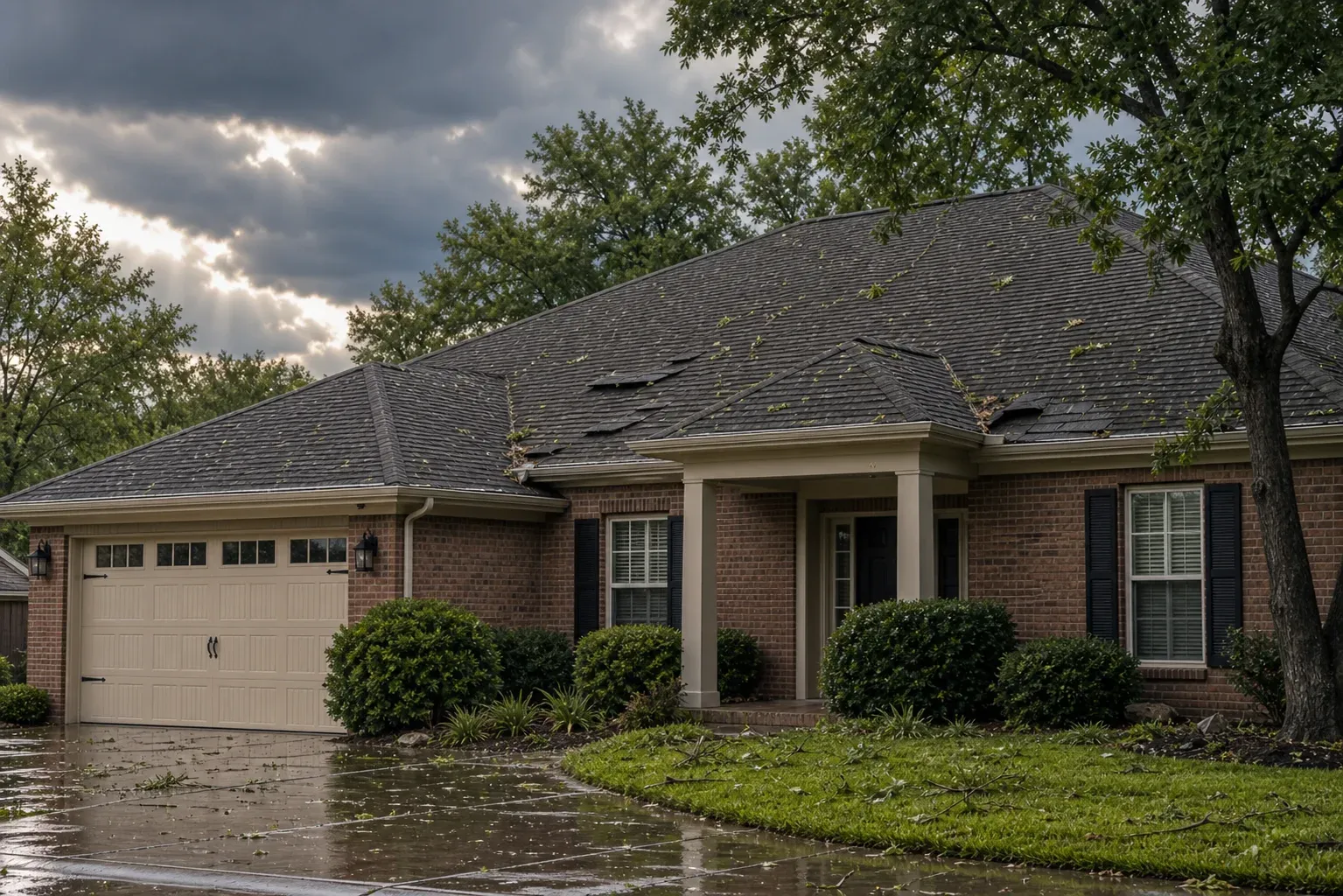
What Storm Season Can Do to Your Roof
Published June 20, 2026
The Piedmont Triad is not a mild-weather market for roofing. Greensboro and the surrounding area see a wide variety of weather events that can damage roofs — sometimes dramatically, sometimes gradually over multiple seasons. Here’s what to know about each type and what to do when one hits.
Spring severe weather season (March–May)
Spring is the most active severe weather period in the Piedmont Triad. Supercell thunderstorms can produce large hail, damaging straight-line winds, and occasional tornadoes. For your roof:
Hail is the most common source of sudden roof damage. Even hail that seems small — 3/4” to 1” diameter — can knock protective granules off asphalt shingles, leaving the underlying asphalt exposed to UV degradation. Larger hail (1.5” and up, which the Piedmont sees several times per decade) can crack shingles, dent metal flashing and gutters, and in severe cases penetrate shingles entirely.
The tricky thing about hail damage is that it often doesn’t cause an immediate leak. You may not know you have significant hail damage until granule loss shows up in your gutters, bare spots appear on shingles, or you notice your roof failing earlier than expected. This is why a post-storm inspection matters even when you don’t see a leak.
High winds can lift shingles — especially at edges, ridges, and corners — create openings for water, and blow debris that damages the roof surface. Lifted or displaced ridge cap shingles are often the first place water gets in.
Summer thunderstorms
Summer convective storms in Greensboro are frequent and can be intense, but typically shorter-lived than spring supercells. The main risk from summer storms is heavy rainfall overwhelming any existing weakness in the roof. A small flashing gap or a section of degraded shingles that hasn’t caused a problem in dry weather can become an active leak during a 2-inch-per-hour summer downpour.
Tropical storm and hurricane remnants (August–October)
While Greensboro is over 250 miles from the coast, the remnants of Atlantic tropical systems reach the Piedmont several times per decade. Tropical Storm Lee, Irene, and several others have caused significant roof damage in the area. Tropical systems typically bring prolonged heavy rainfall over 12–24+ hours rather than brief intense bursts — this sustained soaking is particularly hard on older or damaged roofing.
Hurricane Florence (2018) and Michael (2018) both caused notable roof damage across North Carolina’s interior, including the Piedmont Triad. If your roof was on the older side during either of those events and wasn’t inspected afterward, it’s worth having it looked at.
Winter ice storms (January–March)
The Piedmont Triad sits in a weather transition zone where ice storms are possible most winters. Freezing rain and sleet accumulate differently than snow — they’re heavier and stick to roof surfaces. Significant ice loading is relatively uncommon in Greensboro, but it happens. More practically, ice can form at the roof eaves and in valleys, potentially forcing water back up under shingles in a process similar to ice dams that Northern climates know well.
After an ice event, check for:
- Ice accumulation in valleys and at gutters
- Any cracking sound from the roof (rare but possible with heavy loading)
- Interior ceiling stains or moisture when the ice melts — water may have gotten under shingles
What to do after any significant storm
- Wait for it to be safe before going outside or near the roofline.
- Do a ground-level visual inspection — look for missing or displaced shingles, damaged ridge caps, debris on the roof, and granule accumulation in gutters and downspouts.
- Check inside for any ceiling stains, wet spots, or attic moisture that wasn’t there before.
- Document it — take photos of anything you can see, note the date, and check local weather records for the storm event.
- Call your insurer if you suspect significant damage — they’ll tell you about your deductible and the claims process.
- Get a professional estimate — a roofer can safely inspect the roof surface, document damage with photos, and give you a clear picture of what needs to be done.
Call (743) 229-7664 for a post-storm estimate. We’re familiar with what adjusters look for on hail and wind claims in the Piedmont Triad and can help make sure legitimate damage is properly documented.