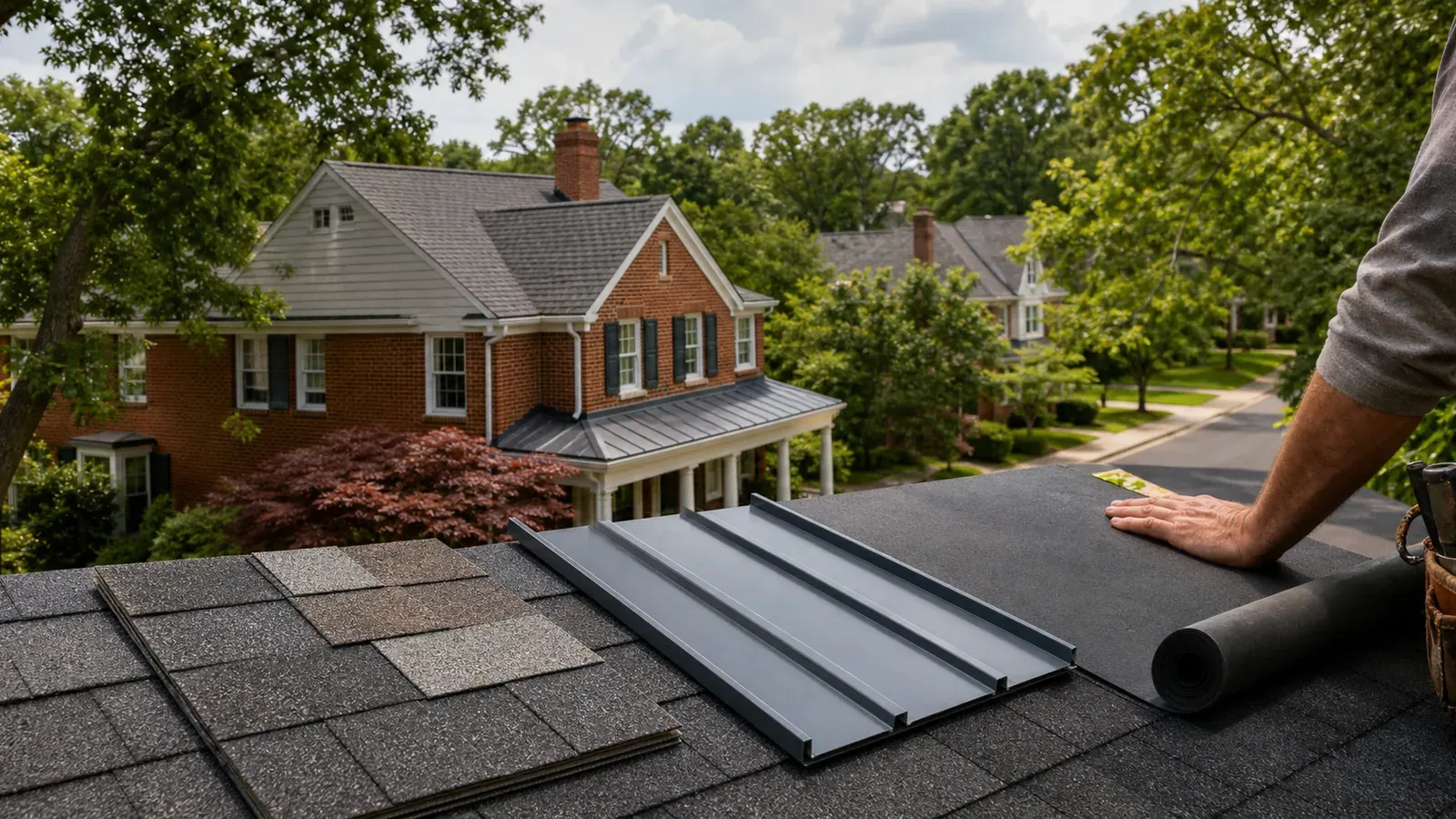
What's the Best Roof for Greensboro's Humid Climate?
Published May 28, 2026
Choosing the right roofing material in the Piedmont Triad means balancing cost against the region’s particular mix of weather: hot, humid summers that encourage algae and moss growth, severe spring thunderstorms with hail and wind, and the occasional heavy rain event from a tropical system moving inland. Here’s how the common options compare for a Greensboro home.
Architectural asphalt shingles
Architectural (dimensional) asphalt shingles are the standard choice for the large majority of homes in Greensboro, High Point, and Winston-Salem, and for good reason — they offer a strong balance of cost, appearance, and performance.
- Typical lifespan: 20–25 years in the Piedmont climate
- Pros: Lowest upfront cost, wide range of colors and styles, straightforward repairs, algae-resistant (AR) granule options available
- Cons: More vulnerable to hail bruising than metal, can develop algae/moss staining without AR granules, shorter lifespan than metal
For most residential roofs in the area, architectural shingles with algae-resistant granules and a class 3 or 4 impact rating are a sensible default.
Metal roofing
Standing-seam and metal panel roofing has become increasingly popular across the Piedmont, particularly for homeowners planning to stay in their home long-term.
- Typical lifespan: 40–60 years
- Pros: Excellent wind resistance, strong hail performance (especially with a Class 4 impact rating), sheds moisture quickly which resists algae and moss growth, minimal long-term maintenance
- Cons: Higher upfront cost than shingles, requires an experienced installer for proper detailing
Over a multi-decade horizon, metal roofing often works out to a comparable or lower total cost than replacing a shingle roof more than once, while also holding up noticeably better in hail and wind events.
Low-slope membrane systems
Flat or low-slope sections — additions, porch roofs, sunrooms, and some commercial buildings — need a membrane system rather than shingles.
- Common options: TPO, EPDM (rubber membrane), and modified bitumen
- Typical lifespan: 15–25 years depending on system and installation quality
- Pros: Handles standing water and ponding far better than shingles on the same slope, relatively quick to install and repair
- Cons: Requires proper drainage design; a poorly sloped or drained membrane roof will develop ponding issues regardless of material quality
Which material makes sense for your home?
- Budget-conscious, standard pitched roof: Architectural asphalt shingles with algae-resistant granules
- Planning to stay long-term, want the best storm resistance: Metal roofing
- Flat or low-slope addition, porch, or commercial section: TPO or EPDM membrane
A roofer can walk your specific roof and give you a straightforward recommendation and free estimate based on your home’s slope, age, and how long you’re planning to stay. Call (743) 229-7664 to schedule a free, no-pressure evaluation.